
Every year, applicants lose weeks to one avoidable problem: a translation that did not give the caseworker what they needed. The visa documents were genuine. The translation simply left something out.
UK Visas and Immigration (UKVI) accepts documents in English or Welsh as they are. Anything else must come with a full English translation that can be checked. The rule looks simple on paper, but small details decide whether a translation is accepted or queried.
This guide explains what UKVI expects, gives you a checklist to run through before you submit, and shows what to double-check on the documents people send most often. Those include birth and marriage certificates, bank statements, academic records and legal papers.
What Do UKVI Translation Requirements Actually Say?
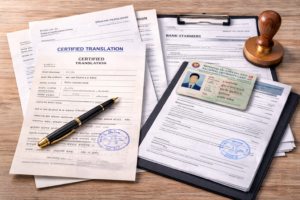
Home Office guidance for supporting documents says a document that is not in English or Welsh must be accompanied by a full translation that can be independently verified. In practice, the translation should contain:
- A confirmation from the translator that it is an accurate translation of the original
- The date of the translation
- The translator’s full name and signature, or those of an authorised representative of the translation company
- The translator’s or company’s contact details
Some routes also ask for details of the translator’s credentials, so read the guidance for your own application. GOV.UK’s page on certifying a document sets out the same core details. Requirements can change, so treat this article as a guide and confirm the current wording before you submit.
What “independently verified” means in practice
The phrase means a caseworker must be able to contact the translator and confirm they produced the work. That is why a signature and real contact details matter more than a decorative stamp. A stamp on its own proves very little. A name, an email address, a phone number and a date give the caseworker something they can actually check.
It also explains why translations by the applicant or a relative tend to be questioned. Even when the English is excellent, nobody independent stands behind the work.
Which Documents Need Translating for UKVI?
Any supporting document that is not in English or Welsh needs a translation. Documents already in English do not. The ones people most often send for translation are:
- Birth, marriage and divorce certificates
- Bank statements and payslips
- Academic certificates and transcripts
- Police clearance certificates
- Employment letters and sponsor letters
- Court orders and other legal documents
Students often underestimate this step. Transcripts and degree certificates must line up with the course and institution details in the application. Our guide to Bengali to English translation for a UK student visa goes deeper on that route.
A Pre-Submission Checklist for Translated Documents
Run through these eight questions before you upload or post anything. Each one maps to a reason translations get queried.
- Is everything translated? Stamps, seals, footnotes and handwritten notes count as part of the document.
- Is there an accuracy statement? It should say the translation is accurate and complete.
- Are the date, full name and signature there? All three should appear on the certificate.
- Do the contact details work? An email address that bounces is as bad as none.
- Do names match the passport? Check every letter, including spacing and hyphens.
- Do dates and numbers match the original? Reference numbers and account numbers need a digit-by-digit check.
- Is each translated page linked to its original page? This is good practice rather than a rule, but it helps a caseworker follow your file.
- Is it clear and legible? Submit a clean scan or print in the format the application asks for.
If you can answer yes to all eight, your translation is in good shape. If not, ask the translator to fix it before you submit, not after a caseworker raises it.
Two Typical Examples of What Goes Wrong
Requirements make more sense when you see how they play out on real paperwork. These two examples are typical of what comes through any translation desk.
A marriage certificate
A marriage certificate often carries a printed section, handwritten entries, an official stamp and a registration number. A translator who converts only the typed text leaves out half of what the caseworker will see. A complete translation describes the stamp, flags handwriting that is hard to read and keeps the registration number exactly as written.
A bank statement
A statement can run to many pages with hundreds of transaction lines. Translating only the summary page, or condensing the rest, leaves gaps. Every page needs translating, and the figures must match the original to the last digit.
If you are preparing financial evidence in Bangla, our page on Bangla bank statement translation shows what a complete translation includes.
What to Double-Check for Each Type of Application
The core requirements stay the same across routes. The details worth extra attention change slightly.
| Application type | What to double-check |
| Family and spouse visas | Names, dates and registration numbers on relationship documents |
| Student visas | Transcripts and certificates matching course and institution details |
| Settlement and ILR | Police certificates and long-residence evidence, with dated certification |
| Visit visas | Complete financial statements and any sponsor letters |
| Court and legal use | Legal terminology, plus any extra rules the court sets |
For family and settlement paperwork, our overview of Bangla immigration translation explains how these files are usually prepared.
Court work is different again, because courts can set their own rules. Read how to translate legal documents for UK courts before you order.
Why Names, Dates and Numbers Cause the Most Trouble
Most queries do not come from bad English. They come from mismatches. A name romanised as Mohammad on one document and Muhammad on another looks like two different people to a system that compares records. Dates can be written in different calendars or numerals. A single wrong digit in a reference number can break the link between two documents.
Three habits prevent most of these problems:
- Give the translator a copy of your passport so they can follow its spellings
- Ask them to note any variation that appears in the original rather than silently correcting it
- Compare the finished translation with your passport and the original before you submit
Figures deserve their own check. If your documents are number-heavy, our number translation service explains how we approach them.
Who Should Prepare Your Translation?
Use an independent professional translator or translation company. Certification is not a regulated title in the UK, so membership of a recognised body can be a useful sign of quality. The main ones are the Chartered Institute of Linguists (CIOL), the Institute of Translation and Interpreting (ITI) and the Association of Translation Companies (ATC).
If your documents are in Bangla, Urdu or Arabic, our certified translation service produces translations with the accuracy statement, date, signature and contact details UKVI looks for.
Notarisation is not normally part of the standard requirement, though some courts and overseas bodies ask for it. Always follow the instructions for your specific application.
On price, expect it to depend on length, language and urgency. To see what is reasonable before you request quotes, read how much you should pay for translation services.
What to Do If UKVI Questions Your Translation
A request for more information is stressful, but it is usually fixable. Keep the steps simple:
- Read the request carefully and note the deadline
- Work out exactly what is missing, such as a signature, a date or a page
- Ask the translator for a corrected certificate and translation
- Send the corrected version before the deadline and keep copies of everything
Most of the problems behind these requests are repeat offenders. We list them in our article on common official document translation mistakes.
Conclusion
UKVI does not ask for anything exotic. It asks for a complete translation, a clear accuracy statement, a date, a signature and contact details a caseworker can use. The difficulty lies in getting every one of those right across every page.
Work through the checklist, compare names and numbers against your passport and the originals, and use an independent professional. Do that, and the translation stops being a risk and becomes a routine part of a well-prepared application.
This guide is general information and not legal advice. For decisions about your own case, check the latest official guidance or speak to a regulated immigration adviser.
Frequently Asked Questions About UKVI Translation Requirements
What are the UKVI translation requirements?
Documents not in English or Welsh must come with a full English translation that can be independently verified. It should include a confirmation of accuracy, the date, the translator’s full name and signature, and their contact details.
Do I need to translate documents that are already in English?
No. Documents in English or Welsh can be submitted as they are. Translation is only needed for documents in other languages, such as Bangla, Urdu or Arabic.
Does UKVI require a notarised translation?
Not normally. A standard application needs a certified translation with a signed accuracy statement. Some courts, institutions or overseas authorities do request notarisation, so check the instructions for your route.
Can I translate my own documents for a UKVI application?
It is not advisable. Official guidance generally points towards a professional translator or translation company, and caseworkers have no independent way to verify a self-prepared translation. An independent translator who signs the certificate is the safer choice.
What happens if my translation does not meet the requirements?
UKVI may ask for further evidence, which can delay your decision. Contact the translator straight away, ask for a corrected certificate or missing pages, and send them before the deadline in the request.