
If you or someone in your family speaks Sylheti at home, you already know how English forms and phone calls can feel like a different world. One misunderstood word on a hospital letter, a council form or a Home Office statement can lead to delays and a lot of stress.
That is why accurate Sylheti to English translation matters. It is not a nice extra. It protects your family’s access to healthcare, education, housing and immigration services across the UK.
This guide explains what Sylheti is, how it differs from Bangla, when you need a translator and when you need an interpreter, and what to check before you book. It also covers a point many providers skip: most written documents from Bangladesh are in standard Bangla, so Sylheti skills matter most in particular situations.
Quick Answer: Do You Need a Sylheti Translator?
Short answer: If you need someone to speak for you at an appointment or meeting, you need a Sylheti interpreter. If you have a written certificate, letter or statement, the document is often in standard Bangla, so you need a certified translator who also understands Sylheti where handwriting, recordings or local phrasing are involved.
What Is the Sylheti Language?
Sylheti is spoken by around 11 million people, mainly in the Sylhet Division of Bangladesh and in parts of north-east India. Estimates put the number of speakers in the UK at several hundred thousand, which makes it one of the most widely spoken community languages in the country.
In the UK, Sylheti-speaking families are concentrated in East London, especially Tower Hamlets, and in Birmingham, Manchester, Luton and Bradford. Many came through family migration from Sylhet over several decades, and the language is still spoken at home by younger generations.
Sylheti has no single standardised writing system. A historic script called Sylheti Nagri survives mainly in religious poetry, while most written communication uses the Bangla script or Latin letters. This is a big reason why Sylheti is so often a spoken language in practice.
Is Sylheti the Same as Bangla?
The honest answer is that experts disagree. Many linguists treat Sylheti as a separate language, while many speakers regard it as a form of Bengali. It is not officially recognised as a language in Bangladesh or India, and standard Bangla is the language of schools and official paperwork.
What matters for translation is how different the two sound and feel in daily use. Sylheti has its own pronunciation, it is described as tonal (unusual among related languages), and it has a large vocabulary with Persian and Arabic influence. Some speakers understand standard Bangla easily because of schooling and media, but others, especially older people and those with limited formal education, may not follow formal Bangla well.
That gap can cause real misunderstandings. Someone who nods politely during an appointment may not have understood the question. Our article on why Sylheti to English translation matters looks at how these gaps affect real cases.
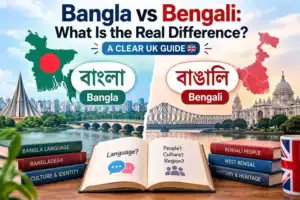
If the naming itself is confusing, our short explainer on Bangla vs Bengali sets out how the two terms are used.
Translation or Interpreting: Which Do You Need?
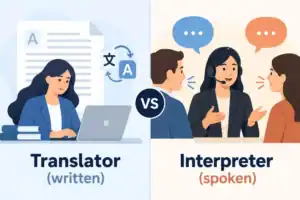
People often use these words interchangeably, but they describe different services. Translation converts written text. Interpreting handles speech in real time. The right choice depends on what you are trying to do, and the two are priced and delivered differently. Our guide to the difference between an interpreter and a translator explains this in more detail.
| Situation | What you usually need | Why |
| A birth, marriage or education certificate from Bangladesh | Certified Bangla to English translation | The document is usually written in standard Bangla, not Sylheti. |
| A GP, hospital or pharmacy appointment | Sylheti interpreter (telephone, video or in person) | The conversation is spoken and needs real-time accuracy. |
| A solicitor meeting, tribunal or asylum interview | Sylheti interpreter, often face to face or by video | Impartiality and precise wording matter. |
| A voice message, recording or handwritten letter in Sylheti | Transcription and translation by someone fluent in Sylheti | Local phrasing and speech patterns need native understanding. |
| A letter, contract or message to a Sylheti-speaking client | English to Sylheti translation | Tone and wording need to feel natural to the reader. |
Sylheti to English Translation Services
Where a written document is involved, the translation should be accurate, complete and properly certified. These are the situations where we see people ask for help most often.
Certified Documents
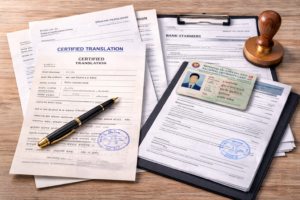
Birth, marriage and death certificates, ID documents and academic records usually need a certified translation for UK use. GOV.UK says a translator should confirm in writing that the translation is true and accurate, add the date, and give their full name and contact details. Our page on certified Bangla to English translation explains what each translation includes.
Immigration and Asylum
Statements, evidence bundles and correspondence for visa and protection claims need particular care, because wording and consistency can be scrutinised closely. See our guide to Bangla translation for asylum cases for what to prepare.
Medical Translation
Discharge letters, prescriptions and consent forms must be exact, since a small slip can change how a clinician understands a patient. We cover this in our page on Bangla to English medical translation.
Legal Translation
Witness statements, contracts and court papers need careful handling of legal terms. Our overview of Bangla legal translation and interpreting shows how this work is approached.
Business and Everyday Correspondence
Letters, emails and official paperwork also come up regularly, for example when a business needs to communicate with a Sylheti-speaking supplier or customer. Our guide to business translation and interpretation in the UK explains the options.
English to Sylheti
Support also runs in the other direction. If you need English information explained or written in a way Sylheti speakers will understand, see our page on English to Sylheti translation.
Sylheti Interpreting Services
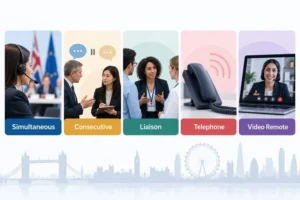
Not every situation needs a document. Sometimes you need someone in the room, or on the line, right now. A dedicated Sylheti interpreter can support you in three main ways.
Telephone Interpreting
Telephone interpreting is the fastest option for urgent calls to a council, the DWP or a GP surgery. Our instant telephone interpreting service is designed for short notice.
Video Interpreting
Video suits remote appointments and online meetings where seeing the interpreter helps. See our online video interpreting services for how it works.
Face-to-Face Interpreting
In-person support suits hospital appointments, tribunals, solicitor meetings and school parents’ evenings. It usually needs advance booking, and our page on professional in-person interpreting across the UK explains the process.
Sylheti interpreting is often needed in sensitive settings such as asylum interviews, family court matters and mental health appointments. In these situations the interpreter must stay impartial, keep everything confidential and interpret everything that is said.
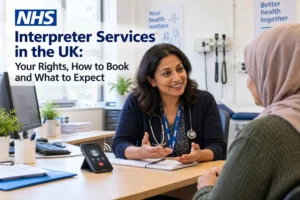
Healthcare is the most common setting. If you work in a health or care team, our guide to translation services in health and social care explains how language support fits into care.
Support in London, Birmingham and Across the UK
Because Sylheti communities are spread across the country, remote interpreting is often the quickest answer. Telephone and video sessions can be arranged for people anywhere in the UK, and face-to-face support can usually be arranged in larger cities with notice.
In the capital, demand is highest in East London, where our page on Bangla interpreting services in East London covers local support.
For the West Midlands, see our page on Bangla translation services in Birmingham.
How to Get the Best Result When You Book
A few simple details make the booking smoother and the interpreting more accurate:
- Say “Sylheti” clearly. Do not simply ask for Bengali or Bangla if Sylheti is your first language.
- Mention your area of origin. Regional variation exists, and it helps the provider find the right match.
- Tell them the setting. Medical, legal, school and immigration appointments each use different vocabulary.
- Ask for a gender preference if it matters. This is especially important in healthcare and family matters.
- Share documents in advance. Letters or forms the interpreter will need to refer to save time.
- Allow extra time. Interpreted appointments take longer because everything is said twice.
How the Translation Process Works
- Send your document or details. Use WhatsApp, email or the contact form. Clear scans of every page, including stamps, help most.
- Get a quote. A good provider gives a fixed, no-obligation price and delivery time before work starts.
- Translation and checking. A qualified Sylheti and English linguist translates the document and a second check follows.
- Certification. Each translation carries a signed statement, the date and contact details.
- Delivery. You receive a PDF by email, and a posted hard copy with an original signature if the receiving organisation needs one.
Why Not Use Free Online Tools?
Free translation tools can help you understand the gist of a short message. They are a poor fit for official documents, and Sylheti is a particular problem because tools tend to perform worse on languages with less written material online.
A machine also cannot give you a signed certification. For more on what goes wrong, see our guide to common official document translation mistakes.
What Does It Cost?
Price depends on the type of service. Documents are usually priced by length and complexity, so a single certificate costs less than a long legal statement. Interpreting is priced by time and format, and urgent or out-of-hours requests often cost more.
Always ask for a clear quote before you commit. Our article on how much you should pay for translation services explains what a fair quote should cover.
How to Choose a Sylheti Language Provider
Ask these questions before you pay:
- Do your linguists speak Sylheti natively, not only standard Bangla?
- Are your translations signed, dated and certified with contact details?
- Are your interpreters qualified, impartial and bound by confidentiality?
- Can you cover telephone, video and face-to-face work?
- How do you protect my personal documents and data?
You can read about our trusted translators and the standards we expect from linguists.
Conclusion
Sylheti to English translation is about more than words. It is about making sure families, patients and applicants are properly understood in the places that matter most: the surgery, the tribunal, the school and the Home Office.
Remember the key distinction. Use an interpreter for spoken situations, use a certified translator for documents, and choose a provider who understands Sylheti as well as standard Bangla. If you are ready to start, contact SE Translations for a quote.
For quick answers to common questions, visit our FAQ page.
Frequently Asked Questions
Is Sylheti the same as Bangla?
They are closely related, but they are not the same in everyday use. Sylheti has its own pronunciation and vocabulary, and experts disagree about whether it is a language or a dialect. For accuracy, spoken sessions should be handled by someone fluent in Sylheti, not Bangla alone.
Do I need a Sylheti translator for my Bangladeshi certificates?
Usually you need a certified Bangla to English translator, because official documents from Bangladesh are normally written in standard Bangla. A Sylheti specialist becomes important for handwritten letters, recordings, affidavits with local wording and any spoken interpreting.
Will my translation be accepted by the Home Office?
A certified translation that follows GOV.UK’s requirements, with a signed statement of accuracy, the date and the translator’s full name and contact details, gives you the strongest chance. Each organisation sets its own rules, so check what yours expects and ask us if you are unsure.
How quickly can I get a Sylheti interpreter?
Telephone interpreting can often be arranged at short notice. Face-to-face interpreting for appointments, tribunals or meetings is best booked in advance, although urgent requests can sometimes be accommodated.
Do you offer Sylheti interpreting outside London?
Yes. We support clients across the UK by telephone and video, and face-to-face interpreters can be arranged in larger cities on request, subject to availability.