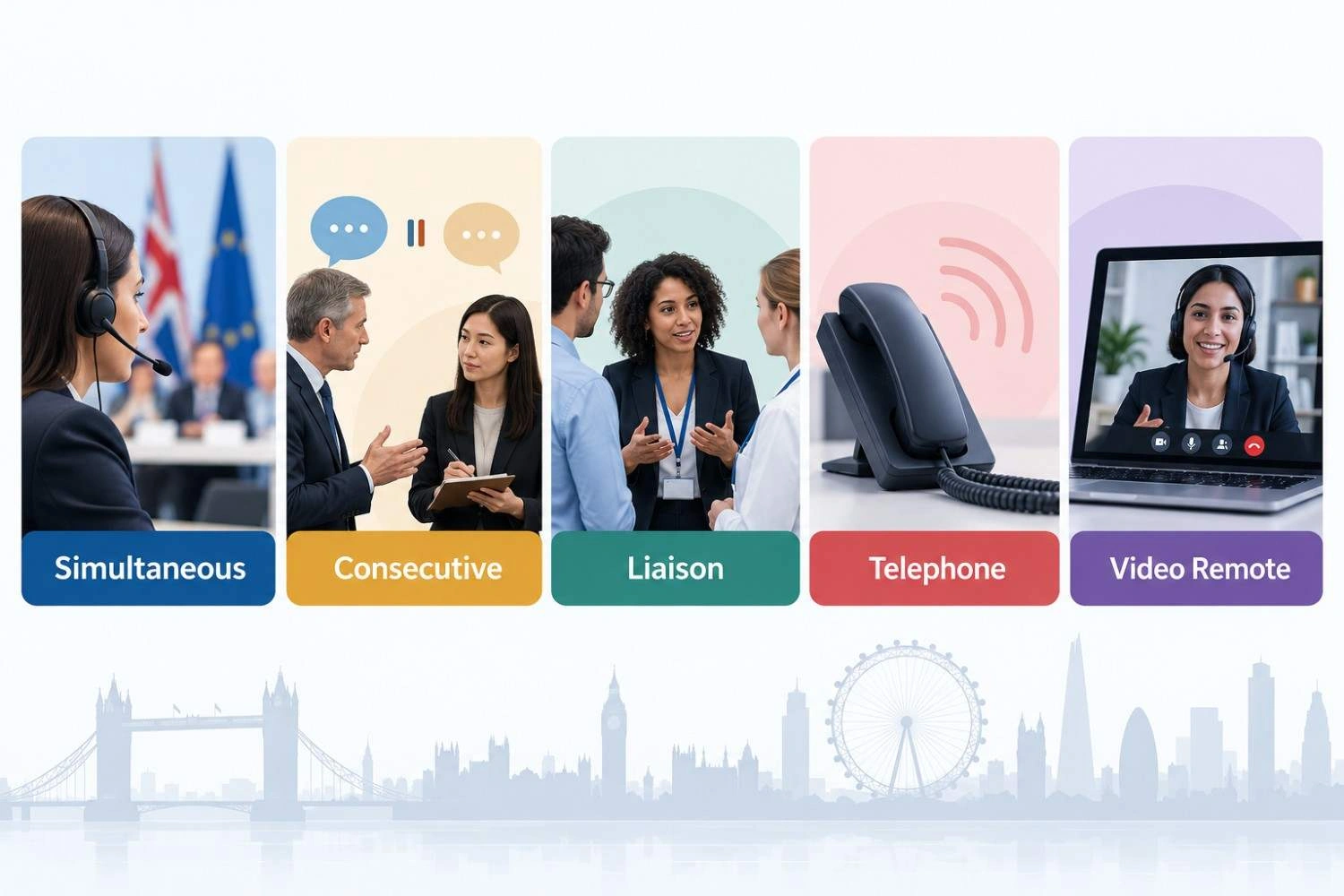
Booking an interpreter sounds easy until you see the options. Simultaneous, consecutive, liaison, telephone, video: every provider seems to use a slightly different list, and it is hard to tell which one fits your situation.
The choice matters more than most people expect. The wrong format can turn a short GP appointment into a stressful hour, leave a conference audience waiting through awkward pauses, or let a client walk out of a legal meeting without really understanding what was agreed. The right one makes the language barrier almost invisible.
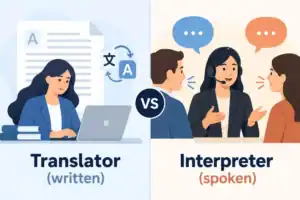
This guide explains the main types of interpreting in plain English, shows where each one works best in the UK, and gives you a simple way to choose. If you are still unsure whether you need an interpreter or a translator, our guide to interpreter vs translator explains the difference in a couple of minutes.
Three ways to think about types of interpreting
Most lists of interpreting types mix up three separate ideas, which is why they feel confusing. It is easier to split them apart:
- Mode: how the message is delivered in time, such as simultaneous or consecutive.
- Delivery method: how the interpreter joins the conversation, in person, by phone or by video.
- Setting: where the interpreting happens, such as a conference, hospital, court or business meeting.
Every real booking combines all three. A GP appointment, for example, is usually consecutive or liaison interpreting in a medical setting, delivered in person or by phone. A trade conference is simultaneous interpreting in a business setting, delivered from a booth or through a remote platform. Once you see the pattern, the options stop looking like a random menu.
Types of interpreting by mode
Simultaneous interpreting
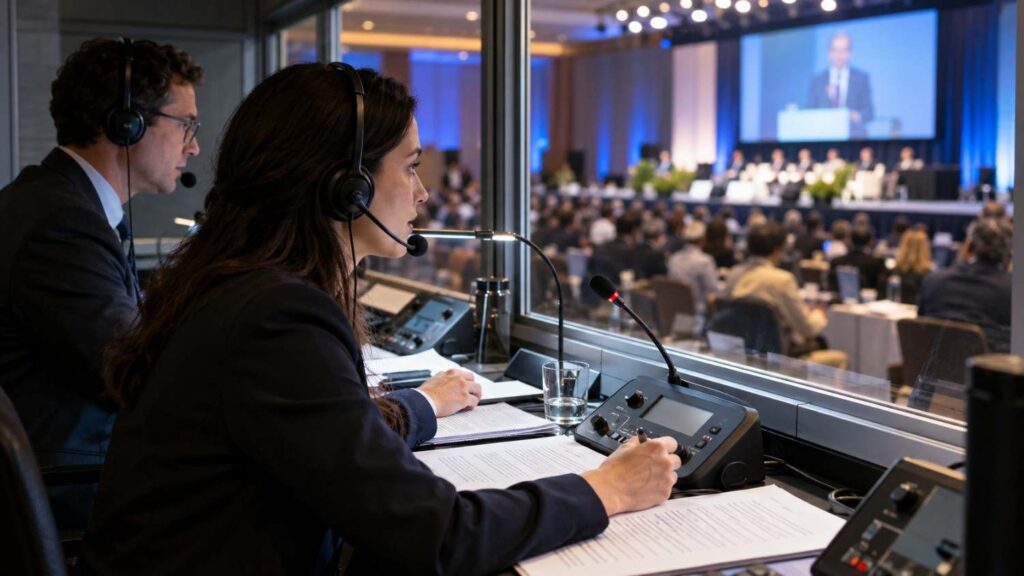
In simultaneous interpreting, the interpreter speaks while the speaker is still talking, with a delay of only a few seconds. At conferences, interpreters sit in a soundproof booth, listen through headphones and deliver the interpretation to the audience through headsets.
It is the best choice when a large audience needs to follow in real time without stopping the event. It is also mentally demanding, so professionals normally work in pairs for each language and swap roughly every 20 to 30 minutes. If a supplier offers a full-day simultaneous job with a single interpreter, treat that as a red flag.
Equipment is the other practical point. Booths, headsets and receivers add cost, and some venues simply cannot fit a booth, so check this early.
Consecutive interpreting
In consecutive interpreting, the speaker talks for a short stretch and then pauses while the interpreter delivers the message in the other language. For longer passages, interpreters often use their own shorthand notes to keep the detail accurate.
This mode suits meetings, interviews, training sessions, site visits and formal talks with a small group. It needs no equipment, and it tends to be very precise because the interpreter hears the whole thought before speaking. The trade-off is time. Everything is said twice, so a meeting can take close to twice as long, and your agenda should allow for that.
For a closer look at how it works in practice, see our page on consecutive interpreting.
Whispered interpreting (chuchotage)
Whispered interpreting is simultaneous interpreting without the booth. The interpreter sits or stands next to one or two listeners and quietly interprets as the speaker talks. It works well when one delegate in an otherwise English-speaking meeting needs support. It does not suit long sessions or bigger groups, because whispering tires the interpreter’s voice and distracts the people nearby.
Liaison interpreting
Liaison interpreting, also called bilateral or dialogue interpreting, is a two-way conversation. The interpreter moves between both languages in short segments, often without notes. It is the style most people meet in everyday life: business negotiations, factory visits, appointments, and meetings with a solicitor or housing officer.
People often confuse it with consecutive interpreting. The difference is mostly length. Consecutive usually covers longer speeches from one speaker, while liaison covers a quick back-and-forth between two parties. In practice, many interpreters switch between the two within the same assignment.
Other types worth knowing
- Sight translation: the interpreter reads a written document aloud in another language, such as a letter handed over at an appointment. It is spoken, so it is not a substitute for a written translation.
- Relay interpreting: two interpreters work in a chain when no single person covers both languages, for example a rare language into English through a third language. It adds time and a little risk of drift, so ask your provider whether it is needed.
- Escort or travel interpreting: the interpreter accompanies visitors on site visits, factory tours or trade fairs.
- Sign language interpreting: British Sign Language (BSL) is a language in its own right, not signed English, and it is booked through registered BSL interpreters. This guide focuses on spoken languages.
Types of interpreting by delivery method
Mode tells you how the message is delivered. The delivery method tells you where the interpreter is.
In-person interpreting
The interpreter is in the room. This is still the best option for sensitive, complex or emotional conversations, because the interpreter can read body language, manage turn-taking and build trust quickly. Think safeguarding meetings, mental health assessments, legal consultations and important negotiations. You can read more about professional in-person interpreting in the UK if that sounds like your situation.
Telephone interpreting
Telephone interpreting connects an interpreter by phone, either within minutes on demand or booked in advance. It is quick and flexible, and it is especially useful for rare languages when nobody local is available. It works best for short, practical conversations such as appointment bookings, customer service calls and urgent updates.
The limits are real, though. The interpreter cannot see faces or documents, which makes long or emotional conversations harder. Everyone should speak slowly and one at a time. If you need help straight away, an instant telephone interpreting service is usually the quickest route.
Video interpreting services

Video interpreting adds a live picture to the call. It is often called video remote interpreting (VRI) when it supports a conversation, and remote simultaneous interpreting (RSI) when the interpreter delivers a live interpretation of a meeting or event through an online platform.
Seeing the interpreter and the speakers helps with tone, gestures and turn-taking, so video is a good middle ground between phone and in-person. It does need a stable connection, decent audio and a quiet space. A poor microphone can undermine even an excellent interpreter. Our page on online video interpreting services in London explains how this works in more detail.
Types of interpreting by setting
Conference and business interpreting
Large events usually call for simultaneous interpreting, while smaller business meetings and negotiations work well with consecutive, whispered or liaison interpreting. Subject knowledge matters here. An interpreter who already understands your industry vocabulary will keep up far better than one meeting those terms for the first time. For bigger events, see our guide to conference interpretation in London.
Medical and healthcare interpreting
Accuracy matters most in healthcare. A mistake with a symptom, a dosage or a consent form can affect someone’s safety. Good practice in the NHS is to use a trained interpreter rather than a relative or friend, especially a child. Family members may not know the medical terms, may soften bad news, or may leave out details to protect someone they love.
Most healthcare interpreting is consecutive or liaison style, in person, by phone or by video. To understand what to expect, read about how an NHS interpreter works.
Legal, court and immigration interpreting
Courts, police stations, solicitors’ offices and immigration appointments need interpreters who know legal terminology and who interpret everything that is said, without summarising or giving advice. Courts and public bodies often have their own booking arrangements, so check who is responsible before you hire anyone privately. For private legal meetings, you may need to arrange an interpreter yourself. Bangla speakers can find more detail on Bangla legal translation and interpreting.
Community and public service interpreting
Schools, housing offices, social services, charities and GP surgeries all rely on community interpreting. It is usually liaison style and often delivered by phone. Confidentiality and impartiality are essential, because the conversations can be personal. Services that also need written documents translated can read our guide to translation services in health and social care.
Quick comparison of the main types of interpreting
| Type | Best for | Delivery | Main drawback |
| Simultaneous | Conferences and large audiences | Booth or remote platform | Needs equipment and two interpreters per language |
| Consecutive | Meetings, interviews and speeches | In person, phone or video | Takes close to twice as long |
| Whispered | One or two listeners in a meeting | In person | Tiring, so limited to short sessions |
| Liaison | Two-way conversations and appointments | In person, phone or video | Needs clear turn-taking |
| Telephone | Urgent, short or rare-language needs | Phone | No visual cues |
| Video | Remote meetings that need visual contact | Online platform | Depends on connection and audio quality |
| Sight translation | Short documents read aloud | In person or remote | Not a written translation |
How to choose the right type of interpreting
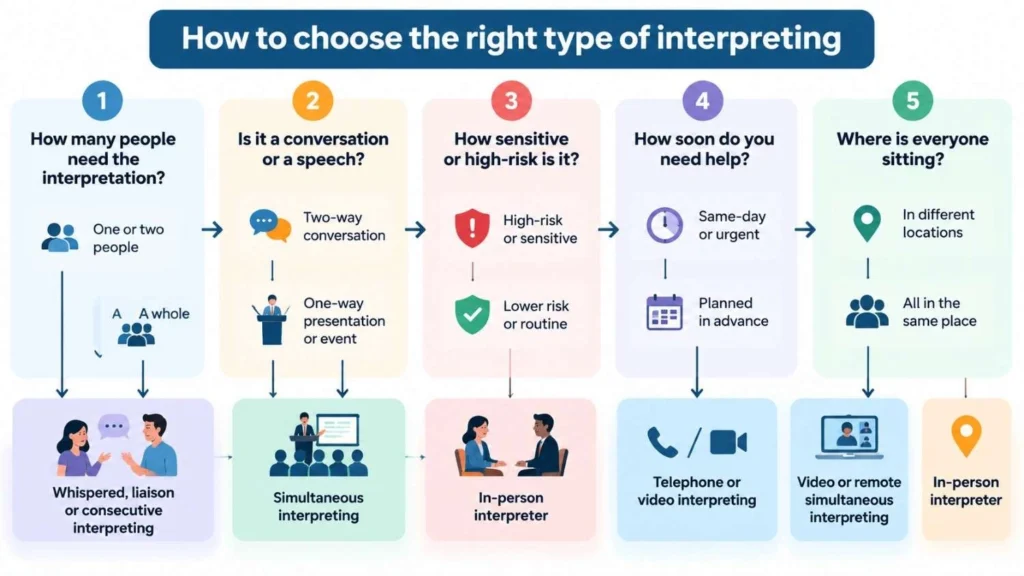
Work through these questions in order. Most bookings are decided by the first three.
- How many people need the interpretation? One or two people point to whispered, liaison or consecutive. A whole room points to simultaneous.
- Is it a conversation or a speech? Two-way conversations suit liaison or consecutive. A one-way presentation suits simultaneous.
- How sensitive or high-risk is it? The higher the stakes, the stronger the case for an in-person interpreter.
- How soon do you need help? Same-day needs usually mean telephone or video.
- Where is everyone sitting? If people are in different places, choose telephone, video or remote simultaneous interpreting.
Language and dialect matter as much as the type
The best format will not help if the interpreter speaks a different variety of the language from the one your client uses. A large share of Bangladeshi families in the UK trace their roots to Sylhet and speak Sylheti at home, so an older patient may find Standard Bangla harder to follow. When you book, mention the dialect or region, not just the language. If this applies to you, our Sylheti interpreter page explains what to ask for.
Arabic works the same way. Gulf, Levantine, Egyptian and Maghrebi speakers can find each other’s everyday speech difficult, so tell your provider where the speaker is from. Our Arabic interpreter UK page covers this in more detail.
What to check before you book an interpreter
Interpreting is not a legally protected profession in the UK, so it pays to check credentials rather than assume them. Useful things to ask about include:
- A recognised qualification, such as the Diploma in Public Service Interpreting (DPSI) or an equivalent degree.
- Membership of the National Register of Public Service Interpreters (NRPSI) for legal and public service work.
- A signed code of conduct covering accuracy, impartiality and confidentiality.
- A DBS check where the work involves children or vulnerable adults.
- Experience in your specific field, such as healthcare, law or engineering.
You can also learn more about the people behind our work on our trusted translators page.
Getting the best from your interpreter
A good interpreter can only work with what you give them. A few small habits make a big difference:
- Send the agenda, documents and any technical terms before the session.
- Explain the purpose of the meeting and flag any sensitive topics in advance.
- Speak in short, clear segments and pause often.
- Look at the person you are speaking to, not the interpreter.
- Do not ask the interpreter for their opinion or to leave things out.
- Allow extra time for consecutive interpreting.
Conclusion
There is no single best type of interpreting, only the best fit for a particular situation. Simultaneous interpreting suits events and large audiences. Consecutive and liaison interpreting cover most meetings and appointments. Telephone interpreting solves urgent and short needs, while video sits comfortably in between.
Start with the setting, then think about the number of people and the level of risk. Add the right dialect, check the interpreter’s credentials, and brief them properly. If you are still unsure, describe your situation to an experienced provider and ask for a recommendation. You can contact the SE Translations team to talk through your options.
Frequently Asked Questions
What are the main types of interpreting?
The main types are simultaneous, consecutive, whispered (chuchotage) and liaison interpreting. They can be delivered in person, by telephone or by video, and they are used in settings such as conferences, healthcare, courts and business meetings. Sight translation and relay interpreting are also common.
What is the difference between simultaneous and consecutive interpreting?
In simultaneous interpreting, the interpreter speaks while the speaker is still talking, usually with the help of headsets. In consecutive interpreting, the speaker pauses and the interpreter then delivers the message. Simultaneous is faster and suits large events. Consecutive needs no equipment and suits meetings and interviews.
Which type of interpreting is best for a medical appointment?
Consecutive or liaison interpreting is usually the best fit, because the conversation goes back and forth in short exchanges. It can be delivered in person, by phone or by video. In-person is often preferred for sensitive or complex consultations, while telephone works well for quick or urgent appointments.
Is telephone interpreting as good as in-person interpreting?
It depends on the situation. Telephone interpreting is fast, flexible and ideal for short conversations. In-person interpreting is better for long, emotional or complex meetings because the interpreter can see body language and shared documents. Video interpreting sits between the two.
What affects the cost of interpreting?
The main factors are the language, the type of interpreting, the length of the booking, the level of notice and the subject matter. Simultaneous interpreting costs more because it needs two interpreters and equipment. Rare languages, urgent requests and travel can also raise the price, and many providers apply a minimum booking time.