Ask ten people what separates an interpreter from a translator and most will say the two jobs are the same. They are not. Both professionals move meaning from one language to another, but they do it in very different ways, with different skills, different tools and different working conditions.
Mixing them up is more common than you might think. People book an interpreter when they actually need a signed, written document. Others send a document to a translator when what they really need is someone in the room on the day. Either mistake costs time and money, and in a legal or medical setting it can cause real problems.
This guide explains the difference between an interpreter and a translator in plain English. You will see what each one does, how they are trained in the UK, where each is used and how to decide which one you need.
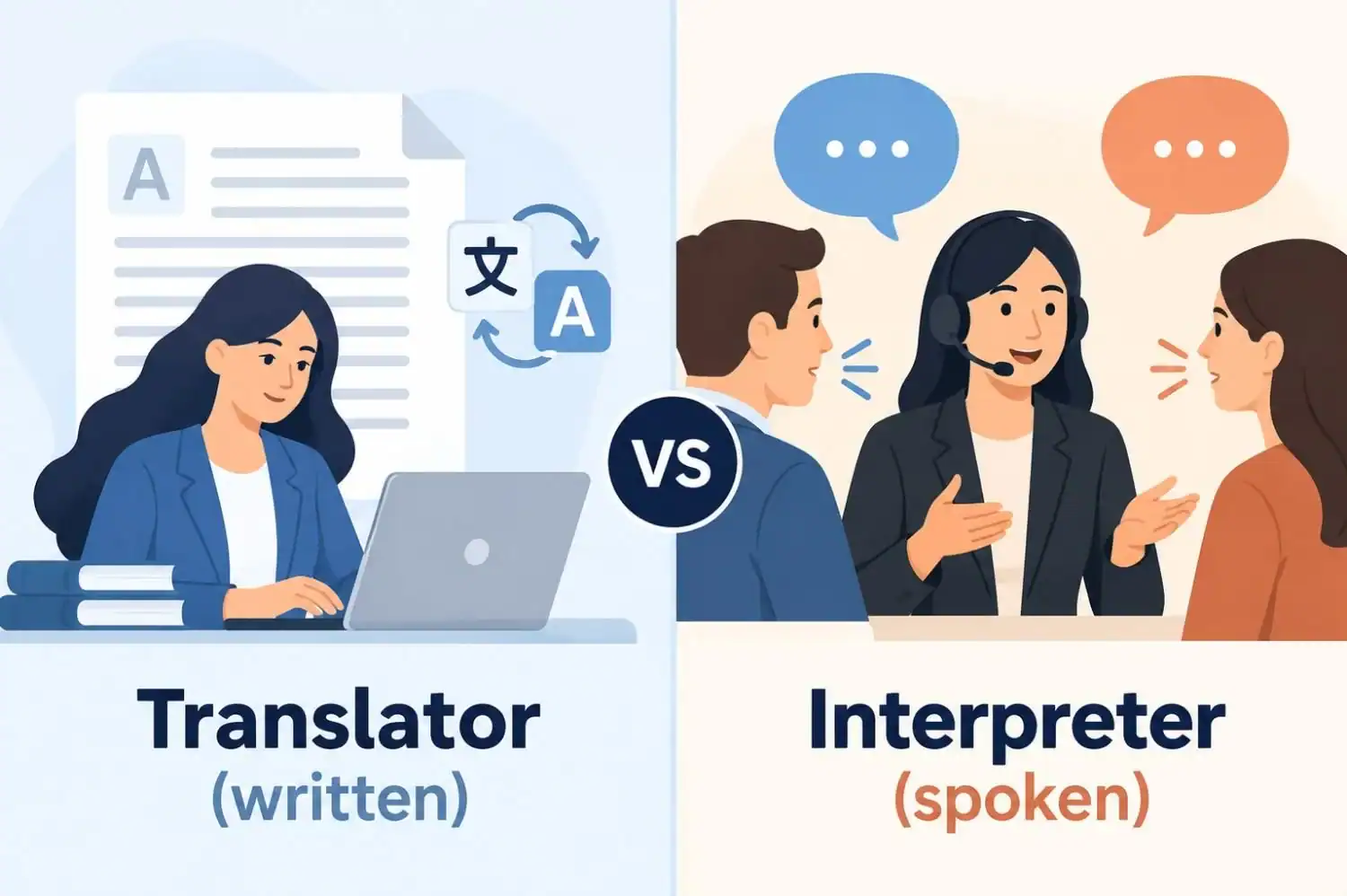
Quick answer: A translator works with written text and turns documents from one language into another. An interpreter works with speech and turns spoken words into another language in real time. Translation is about documents. Interpretation is about conversations.
Interpreter vs Translator: The Core Difference
The simplest way to remember it is this: translators deal with the written word, while interpreters deal with the spoken word. Everything else follows from that one point.
A translator usually works alone, at their own pace, with reference books, glossaries and software close at hand. They can research a difficult term, rewrite a sentence three times and ask a colleague to proof the final version. An interpreter has none of that comfort. They listen, understand and speak again in a matter of seconds, and there is no delete key.
That is why many professionals choose one path and stay on it. The two careers draw on the same language knowledge, yet the day-to-day skill sets are quite different. If you want a broader view of how written work is handled, our translation services page shows the types of documents we deal with every week.
What Does a Translator Do?

A translator converts written content from a source language into a target language. The goal is not a word-for-word swap. A good translator keeps the meaning, tone and purpose of the original, so the finished text reads as if it had been written in the new language from the start.
In practice, the work involves more than most people expect. A translator reads the whole document first, checks specialist terms, follows any layout or formatting rules and then proofreads the final version. For official documents, they also add a statement confirming that the translation is complete and accurate.
Documents translators commonly handle
- Birth, marriage and divorce certificates
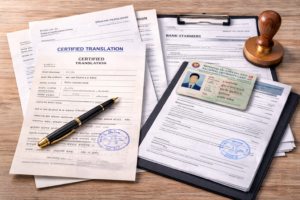
- Passports, ID cards and bank statements
- Academic transcripts and degree certificates
- Contracts, court papers and witness statements
- Medical reports and discharge summaries
- Websites, brochures and business reports
For anything going to a UK authority, the translation usually has to be certified. That means the translator or agency signs a statement that the document is a true and accurate rendering of the original, with their name, contact details and the date. If this is new to you, our certified translation guide for the UK walks through exactly what is required.
Specialist subjects need specialist knowledge. A contract, for example, depends on exact legal wording, which is why legal translation is best left to a translator who understands legal systems as well as languages. The same applies to medical translation, where one wrong term in a report can change a diagnosis.
Skills a good translator needs
Strong writing comes first. A translator must write beautifully in their target language, which is almost always their native one. After that come careful research habits, subject knowledge, attention to detail and comfort with translation tools such as glossaries and translation memory software. Patience helps too, because the best results often come from the third or fourth read-through.
What Does an Interpreter Do?
An interpreter helps people who speak different languages communicate in real time. They listen to the speaker, understand the message in full and deliver it in the other language without adding, removing or softening anything.
Accuracy is only part of the job. Interpreters also manage the flow of a conversation, stay neutral and keep everything confidential. A good one is almost invisible, so both sides feel they are speaking directly to each other.
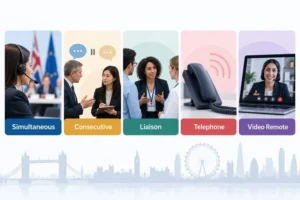
Interpreting comes in several modes, and the right one depends on the setting.
Consecutive interpreting
The speaker talks for a short stretch, then pauses while the interpreter delivers the message. This is the most common style for medical appointments, solicitor meetings, interviews and small business talks. It takes a little longer because every sentence is said twice, but it allows great accuracy. You can read more about how consecutive interpreting works in everyday settings.
Simultaneous interpreting
Here the interpreter speaks almost at the same time as the speaker, usually from a soundproof booth with headsets. It suits conferences, large meetings and live events. The mental load is heavy, so simultaneous interpreters normally work in pairs and swap every twenty to thirty minutes. For larger events, see our conference interpretation service in London.
Whispered interpreting
Also called chuchotage, this is a quiet form of simultaneous work. The interpreter sits beside one or two listeners and whispers the translation as the speaker talks. It works well when only a small number of people need support in an otherwise single-language meeting.
Telephone and video interpreting

Remote interpreting has grown quickly, especially for short-notice needs. A telephone call can connect you to an interpreter in minutes, while video adds body language and visual cues. If you need help at short notice, an instant telephone interpreting service or online video interpreting can be the faster route.
Translation vs Interpretation: Side-by-Side Comparison
The table below sums up the main differences between translation and interpretation, so you can compare them at a glance.
| Feature | Translator | Interpreter |
| Type of content | Written text | Spoken language |
| Main skill | Writing, research, accuracy | Listening, memory, speaking |
| Timing | Works to a deadline, at their own pace | Works live, in real time |
| Tools | Dictionaries, glossaries, translation software | Headsets, booth, notepad, phone or video link |
| Direction | Usually into their native language | Often both directions during a conversation |
| Typical settings | Offices, remote desks | Hospitals, courts, meetings, conferences, calls |
| Output | Documents, often certified | Spoken message, no written record |
| Pricing | Usually per word | Usually per hour or per day |
Interpreter vs Translator in Real Life: Four Examples
Definitions are useful, but examples make the difference stick. Here are four situations we see regularly.
1. A GP appointment
A patient who speaks little English needs to describe symptoms and understand the doctor’s advice. That calls for an interpreter, either in the room or on the phone. If the patient later needs a hospital letter explained in writing, that is a translator’s task. Healthcare often needs both, which we discuss in our guide to translation services in health and social care.
2. A UK visa application
Supporting papers such as certificates, bank statements and ID need a certified translation. The visa interview, if there is one, needs an interpreter. Two different professionals, two different tasks, one application. Families often come to us for help with Bangla immigration translation for exactly this reason.
3. A court hearing
Witnesses and defendants need an interpreter to follow what is said and to give evidence. Written evidence, contracts and statements in a foreign language need a translator. Courts take accuracy very seriously, so qualified professionals matter at every stage.
4. A business meeting with overseas partners

A face-to-face negotiation needs an interpreter, often in consecutive mode. The follow-up contract, product sheets and marketing copy need a translator. Many companies also hire an in-person interpreter for site visits, where understanding body language and tone can make or break the deal.
Training and Qualifications in the UK
The UK does not require a single licence to work as a translator or interpreter, so qualifications and professional membership are the best signs of quality. When you hire, look for proof of both training and experience.
- Interpreters: the Diploma in Public Service Interpreting (DPSI) is a recognised qualification, and the National Register of Public Service Interpreters (NRPSI) lists vetted public service interpreters.
- Translators: a degree or postgraduate qualification in translation, the Chartered Institute of Linguists (CIOL) Diploma in Translation and membership of bodies such as the Institute of Translation and Interpreting (ITI) all show professional standing.
- Both: a clear code of conduct covering impartiality and confidentiality, plus a DBS check for work with children or vulnerable adults.
You can verify credentials directly with CIOL, ITI and NRPSI. At SE Translations, we explain how we choose and check our linguists on our about us page.
Can One Person Be Both an Interpreter and a Translator?
Yes, and many professionals are. Still, being good at one does not automatically make someone good at the other. A gifted translator may freeze when asked to interpret live, and a fast interpreter may not have the patience for a 40-page legal contract.
So when you hire, ask what the person does most often. A linguist who works daily in the mode you need will almost always deliver a better result than a generalist who does a bit of everything.
How to Decide: Do You Need an Interpreter or a Translator?
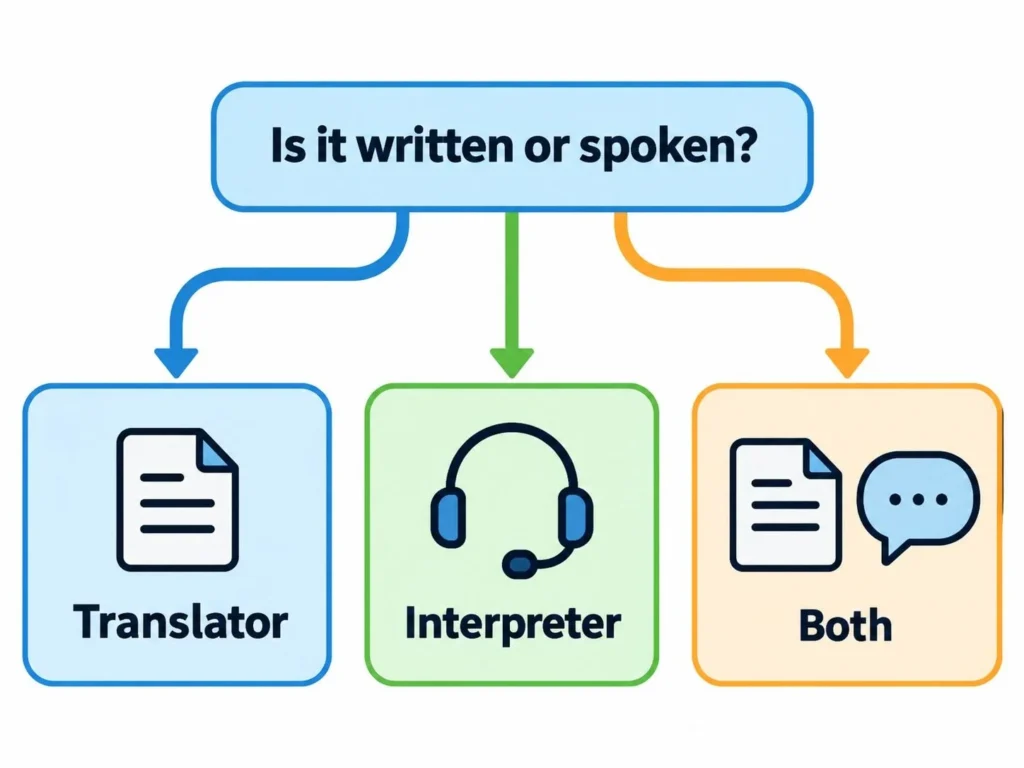
Start with one question: is the content written or spoken?
- Written content (documents, certificates, websites, emails, contracts): you need a translator.
- Spoken content (meetings, appointments, interviews, hearings, calls): you need an interpreter.
- Both (a legal case, a visa application, a medical treatment plan): you need a translator for the paperwork and an interpreter for the conversations.
Next, think about timing. Translation can usually be planned around a deadline, while interpreting happens at a fixed moment and the professional must be there on time. For urgent spoken needs, remote interpreting is often the fastest option.
Cost and Turnaround: What to Expect
Translators generally charge by the word, with the price shaped by language pair, subject and deadline. Interpreters usually charge by the hour or by the half or full day, often with a minimum booking and travel time for in-person work.
Prices vary from one provider to another, so it helps to know what drives the cost before you ask for a quote. Our guide on how much you should pay for translation services breaks this down clearly.
Common Mistakes People Make
Using a friend or family member to interpret
It feels cheaper and easier, but it often backfires. Family members may leave out bad news, add their own opinions or struggle with medical and legal terms. Impartiality matters, and a trained interpreter provides it.
Relying on machine translation for official documents
Online tools are handy for getting the gist of a text. They are not suitable for documents that go to the Home Office, a court or a university, because they cannot certify accuracy or take responsibility for errors. Our article on common official document translation mistakes shows what tends to get applications delayed.
Booking the wrong service
This is the classic mix-up. Always check whether your need is written or spoken before you request a quote. If you are unsure, a good provider will ask the right questions and guide you.
Conclusion
The interpreter vs translator question comes down to one idea. Translators work with written text, usually at their own pace, and deliver documents that can be certified and filed. Interpreters work with spoken language, in the moment, and make live conversations possible. Both roles are skilled, regulated by professional standards rather than one licence, and vital in a multilingual country like the UK.
Choose the right professional and your documents are accepted, your meetings run smoothly and nothing gets lost along the way. If you are still not sure which one you need, get in touch with our team and we will point you to the right service.
Frequently Asked Questions
What is the main difference between an interpreter and a translator?
A translator converts written text from one language into another, while an interpreter converts spoken words in real time. Translators work with documents and have time to research and revise. Interpreters work live, in meetings, appointments and hearings, and must deliver accurate meaning on the spot.
Can a translator work as an interpreter?
Some can, but the two skill sets are different. Translation rewards careful writing and research, while interpreting needs quick listening, memory and confident speaking. Many professionals specialise in one, so it is best to hire someone who does your type of work every day.
Which is harder, translation or interpretation?
Neither is easier, they are just hard in different ways. Interpreting puts the linguist under real-time pressure with no chance to correct mistakes. Translation demands very high written accuracy, subject knowledge and polished style, often across long and technical documents.
Do I need an interpreter or a translator for a UK visa application?
You will most likely need both. Documents such as certificates, bank statements and ID need a certified translation from a translator. If you attend an interview or appointment, you may need an interpreter. Always check the current requirements on the official GOV.UK guidance for your visa type.
How much do translators and interpreters charge in the UK?
Translators usually charge per word, while interpreters charge per hour or per day, with minimum bookings. The final price depends on the language, the subject, the deadline and whether the work is remote or in person. Asking for a clear written quote before you commit is always a good idea.