Imagine sitting in a GP surgery with a worrying symptom and not having the words to explain it. You know exactly what hurts, but the English vocabulary will not come. For the roughly one million people in the UK who speak little or no English, that is not a thought experiment. It is a regular part of using the health service.
This is where an NHS interpreter comes in. A trained interpreter helps you and your clinician understand each other clearly and accurately, and it should not cost you anything. Yet many patients do not know they can ask for one, and many staff are unsure how to arrange it.
This guide explains how NHS interpreter services work, what your rights are, how NHS interpreter booking happens in GP practices and hospitals, and how to choose between telephone and in-person support. It is written for patients, families and healthcare staff, and it draws on current NHS England guidance and Healthwatch advice.
Quick Answer: Does the NHS Provide an Interpreter?
Yes. NHS providers are expected to arrange a professional interpreter when language is a barrier, and the patient does not pay. Tell the practice or hospital your language when you book, ask for an interpreter by name, and ask them to confirm the booking before you attend.
What Is an NHS Interpreter?
An NHS interpreter is a trained language professional who relays spoken conversation between a patient and a health professional, in both directions, in real time. They work in GP surgeries, hospitals, pharmacies, community clinics and mental health services.
Most interpreters are not NHS employees. NHS England explains that interpreting is usually commissioned from outside providers, often through commercial frameworks such as those run by Crown Commercial Service. A few large trusts also run in-house teams. So the person joining your appointment may work for an agency, but the job is the same: to help you be understood.
Interpreter or Translator?
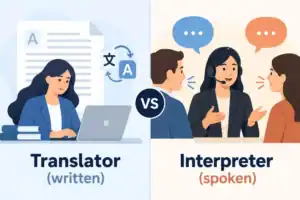
People often use these words as if they mean the same thing, but they do not. An interpreter works with speech, live. A translator works with written text, such as a discharge letter or a test result. If you are unsure which one you need, our guide to the difference between an interpreter and a translator explains it in plain English.
Who Pays for It?
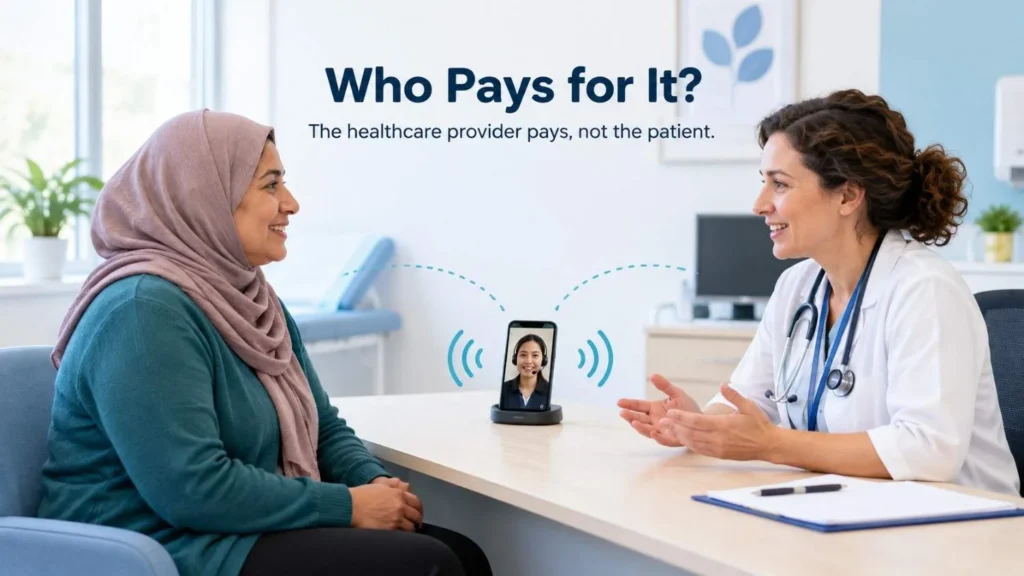
The healthcare provider pays, not the patient. In primary care, integrated care boards (ICBs) are responsible for making sure interpreting and translation services are available. NHS England does not hold booking details itself, so the route differs from one area to another.
One NHS England economic estimate puts spending at around £75.5 million a year, against an estimated £250 million to £300 million needed to meet the wider need. That gap helps explain why provision still feels patchy, and why asking clearly matters.
Do You Have a Right to an NHS Interpreter?
In practice, yes. Healthwatch explains that it is the provider’s responsibility to arrange an interpreter, and that NHS guidance says a professional should be offered whenever language gets in the way of discussing health matters.
The legal backdrop is the Equality Act 2010 and the NHS Act 2006, as amended. NHS England’s framework cites both as placing duties on NHS organisations to communicate in an accessible and inclusive way.
You should also expect a little extra time. Healthwatch notes that appointments should be longer when an interpreter is involved, because every sentence is effectively said twice.
A word of honesty, though. Availability is not perfect, and NHS England itself describes provision as inconsistent across the country. Knowing your rights, and stating them politely but firmly, makes a real difference.
Types of NHS Interpreter Services
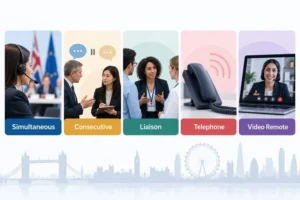
NHS interpreter services usually come in three forms. The right one depends on the appointment, the urgency and the needs of the person involved.
NHS Telephone Interpreter
An NHS telephone interpreter joins the appointment by phone. The member of staff dials the service, chooses the language and is connected, often within a minute or two. University College London Hospitals, for example, says its telephone service connects patients to a qualified interpreter in under a minute.
This option suits short, routine contacts: booking an appointment, a same-day visit, or a quick chat at the pharmacy counter. Independent providers, including our instant telephone interpreting service, work on the same principle: connect fast, speak, finish.
Where it struggles is with long, emotional or complex consultations. Without visual cues it is harder to read hesitation or distress, and a poor line can break the flow.
NHS Face-to-Face Interpreter
An NHS face-to-face interpreter attends in person. Many trusts keep this for situations where nuance matters most, such as mental health assessments, consent discussions, maternity care and difficult news. The Royal Free London, for instance, says most of its patients receive telephone interpreters, with in-person interpreters booked when there is a specific need.
In-person interpreting lets the interpreter notice body language, reassure an anxious patient and adapt to hearing or vision needs. The trade-off is lead time, since it usually has to be booked in advance. Our page on professional in-person interpreting across the UK explains how that works.
Video and British Sign Language Interpreting
Video interpreting sits between the two. The interpreter appears on a screen, so expressions and gestures are visible, but nobody has to travel. For Deaf patients, video is especially important: NHS 111 offers a British Sign Language service through the InterpreterNOW app, 24 hours a day, 365 days a year.
BSL is now recognised as an official language in England, although NHS England’s community language framework focuses on spoken languages and written translation, with BSL covered through separate accessible information guidance. If you need video support for a spoken language, see our online video interpreting services.
| Type | Best for | Speed | Main limitation |
| Telephone | Short, routine or urgent contacts | Very fast, often within minutes | Harder for long or emotional talks |
| Face-to-face | Consent, mental health, maternity, sensitive news | Needs advance booking | Travel, cost and availability |
| Video | Medium-complexity visits, remote areas, BSL | Fast if the technology works | Needs a stable connection and a device |
How to Book an NHS Interpreter
NHS interpreter booking is not identical everywhere, because each area commissions its own service. The steps below work in most places.
If You Are a Patient
- Say it at the start. When you call or register, say “I need an interpreter” and name your language. Some areas, such as Newcastle, advise patients to say the word “interpreter” followed by their language when they phone.
- Be specific about the dialect. Bangla and Sylheti are not the same, and Arabic has many regional varieties. The more precise you are, the better the match.
- Mention any preferences. If you would feel more comfortable with a male or female interpreter, say so. NHS England’s framework encourages trusts to record this in patient records.
- Ask your GP to include your language in referrals. That way the hospital knows to arrange an interpreter before you arrive.
- Check a few days beforehand. Contact the hospital department to ask whether an interpreter is booked. If not, ask them to arrange one.
- Book the next one before you leave. The Royal Free advises patients to tell reception before leaving the clinic if they need an interpreter for a follow-up.
If You Work in Healthcare
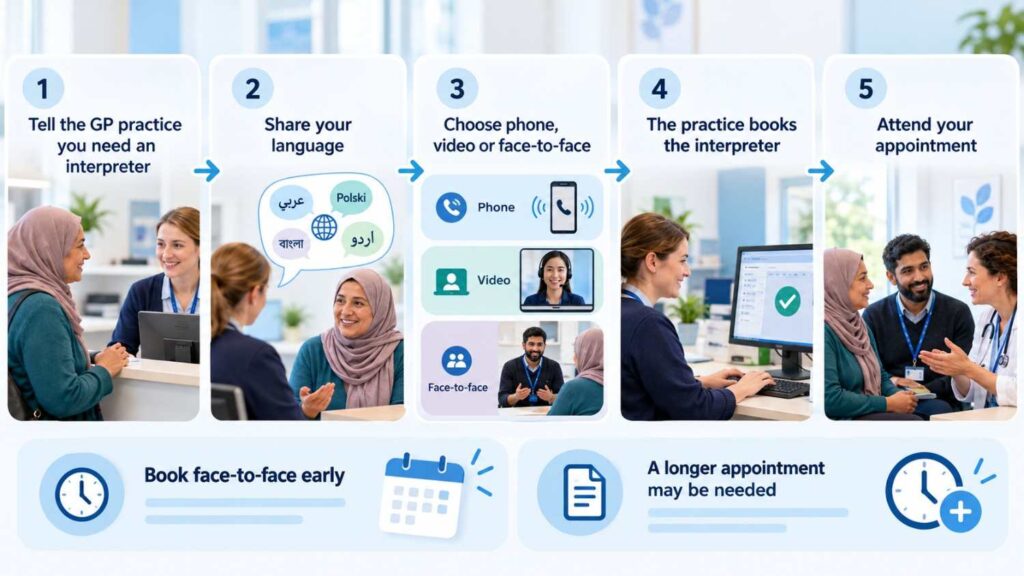
For staff, the biggest fixes are simple ones. NHS England’s improvement framework recommends recording a patient’s language need in the electronic patient record as early as possible and carrying it into every referral. It also suggests appointing a local lead for interpreting and training receptionists, who are usually the first to hear about a language need.
Hampshire and Isle of Wight ICB offers a useful example. A review found that only 101 of 1,082 eligible primary care sites had language support. The ICB moved to a single spoken language provider and gave each GP practice a unique ID number to simplify access. Between 2022 and 2024, usage rose from 67,375 to 265,668 minutes.
Two practical reminders. First, NHS England does not hold contact details for interpreting providers, so start with your local ICB. Second, book face-to-face interpreters early and allow a longer appointment slot.
Telephone or Face-to-Face? How to Choose
There is no single right answer, but one rule of thumb works well: the higher the risk and the more emotional the conversation, the stronger the case for an in-person interpreter.
Choose face-to-face when:
- Informed consent is needed for surgery or treatment
- The appointment involves maternity care or an ultrasound scan
- It is a mental health assessment
- There are safeguarding concerns or a sensitive disclosure is likely
- The patient is receiving a serious diagnosis
- The patient has hearing, cognitive or literacy challenges
Choose telephone when:
- Booking or rearranging an appointment
- The visit is a short follow-up or a pharmacy query
- Support is needed urgently, on the same day
- The language is rare and no local interpreter is available
Nottingham University Hospitals describes this blended approach in NHS England’s framework. Its plan is to prioritise face-to-face interpreting for higher-risk clinical interactions, while telephone interpreting becomes the main channel for routine appointments.
Whichever format you choose, most medical appointments rely on consecutive interpreting, where the speaker pauses after a few sentences so the interpreter can relay each part accurately.
Why Professional Interpreters Matter More Than You Think
Family Members Are Not a Safe Substitute
It feels natural to bring a son, daughter or friend. Patients are allowed to make that choice, and trusts such as the Royal Free say they will respect it, while explaining the risks. The Royal Free also warns that the error rate of untrained interpreters can make them riskier than having no interpreter at all.
Why? Relatives may skip words they find embarrassing, soften bad news or miss medical terms. A teenager may be asked to explain something no child should have to. There are safeguarding concerns too, because a patient may not feel able to speak openly about abuse when a relative is doing the interpreting. NHS England’s framework raises exactly this point.
Translation Apps Are Not a Clinical Tool Yet
AI translation apps are now common in busy clinics. They are quick and convenient, but NHS England has flagged concerns about accuracy and patient safety, especially for sensitive tasks such as medication instructions. If a translation is incomplete, a patient cannot give properly informed consent.
What the Evidence Shows
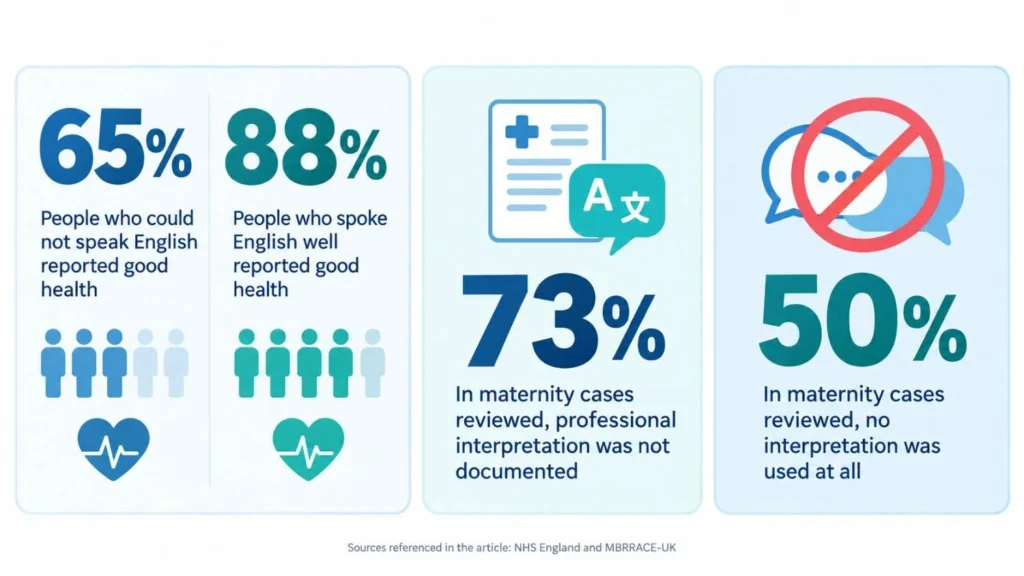
The numbers are sobering. In the 2011 census data cited by NHS England, only 65% of people who could not speak English reported good health, compared with 88% of those who spoke it well. MBRRACE-UK, which reviews maternal and infant deaths, found that in 73% of the maternity cases it examined, professional interpretation was not documented, and in 50% no interpretation was used at all.
Written information matters too. An investigation by the Health Service Safety Investigations Body described a child whose MRI scan was cancelled twice. The family had spoken support, but appointment letters were sent only in English, so they did not realise the child needed to fast. The lesson is that interpreting and translation must work together. For appointment letters, discharge summaries and test results, see our guide to medical translation.
What Makes a Good NHS Medical Interpreter in the UK?
Not every bilingual person is a qualified interpreter. When people search for an NHS medical interpreter UK services can rely on, they are really asking one question: how do I know this person is qualified? These are the markers to look for.
- Qualifications. NHS England says it will work towards a mandatory minimum of Level 3 for interpreters, with Level 6 or 7 interpreters used in critical situations such as emergency consent. The Level 6 Diploma in Public Service Interpreting (DPSI), with a health option, is widely treated as the benchmark.
- Registration. The National Register of Public Service Interpreters (NRPSI) is the independent voluntary regulator. Registered interpreters follow a published Code of Professional Conduct, and the register is free to search online.
- Confidentiality. NHS England’s framework recommends that interpreters complete confidentiality forms, which supports patient trust.
- Impartiality. A good interpreter does not advise, answer for the patient or summarise. Everything said is interpreted.
- Cultural awareness. Understanding how a community talks about pain, mental health or family decisions helps avoid misunderstandings.
You can read more about our trusted translators and the standards we expect from linguists.
What to Expect During an Interpreted Appointment
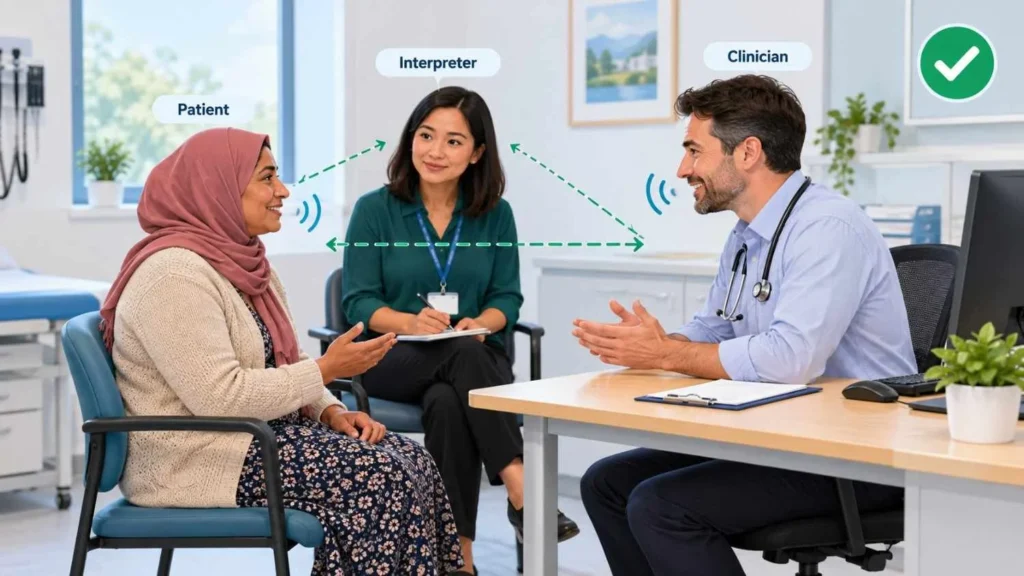
If you have never used an interpreter before, the first few minutes can feel awkward. A few habits make the conversation smoother for everyone.
- The interpreter introduces themselves and explains that everything will be interpreted and kept confidential.
- They speak in the first person. If you say you have a headache, they say “I have a headache”, not “she says she has a headache”.
- Speak to the clinician, not the interpreter, and use short sentences with natural pauses.
- Ask for anything to be repeated or explained again. Nobody should rush you.
- Avoid side conversations. If something is said in the room, it should be interpreted.
Language and Dialect: Why the Details Matter
Asking for an interpreter in “Bengali” or “Arabic” is a start, but it is sometimes not enough. The dialect can decide whether the conversation works.
Take Sylheti, spoken by many families in East London and other parts of the UK. It is often treated as a dialect of Bengali, yet some patients, especially older speakers or those with limited schooling, are far more comfortable in Sylheti than in standard Bangla. A patient who nods politely may not have understood. Our article on why Sylheti to English translation matters explains the issue in more depth.
The words Bangla and Bengali are also used interchangeably, which can confuse booking forms. Our short explainer on Bangla vs Bengali clears up the difference.
Arabic works in a similar way. Modern Standard Arabic is used in writing, but patients speak regional varieties such as Egyptian, Levantine, Gulf or Maghrebi Arabic. When you book, name the country or region as well as the language. An experienced Arabic interpreter in the UK will usually ask this before the assignment.
Demand is especially high for Bangla speakers in the capital, which is why specialist Bangla interpreting services in East London exist.
Common Problems and How to Fix Them
- No interpreter turned up. Tell reception straight away and ask for a telephone interpreter instead of rebooking. Many trusts can connect one within minutes.
- Staff asked you to bring a relative. Politely say you would prefer a professional interpreter and that the provider is responsible for arranging one.
- Wrong language or dialect. Say so early and ask for a different interpreter.
- The appointment felt rushed. Ask for a longer slot next time. Extra time is part of good practice when an interpreter is used.
- You are worried about confidentiality. This is common in small communities. Ask for an interpreter from outside your local area, or request a telephone interpreter.
- You were refused or ignored. Contact the Patient Advice and Liaison Service (PALS) at the hospital or ask your local Healthwatch for help.
For a wider view of how language support fits into care settings, see our guide to translation services in health and social care.
When Independent Interpreting Providers Can Help
NHS-commissioned contracts cover most NHS appointments, but not every healthcare situation. Private clinics, care providers, charities, community organisations and legal teams working on medical matters often arrange their own language support.
SE Translations is an independent UK language service provider and is not part of the NHS. We provide interpreting in Bangla, Sylheti and Arabic, along with medical document translation, for organisations that need accurate and confidential communication. If you are comparing options, our guide on how much you should pay for translation services explains what affects the price.
You can also contact our team with your language, location and appointment type, and we will talk through the options.
Conclusion
An NHS interpreter is not a favour. It is a basic part of safe, fair and effective care. When language gets in the way, misdiagnosis, medication errors and missed appointments become far more likely, and the evidence from NHS England and national investigations makes that clear.
If you are a patient, say early that you need an interpreter, name your language and dialect, and ask for the booking to be confirmed. If you work in healthcare, record language needs, plan for longer appointments and match the type of interpreter to the risk of the conversation. Above all, choose qualified professionals over relatives and apps.
Good communication is where good care begins. Still have questions? Our FAQ page covers many common interpreting queries.
Frequently Asked Questions
Does the NHS provide an interpreter for free?
Yes. The healthcare provider arranges and pays for a professional interpreter, so you should not be charged. This applies across GP surgeries, hospitals, pharmacies and other NHS services. Ask for one when you book your appointment.
How do I book an NHS interpreter for a GP or hospital appointment?
Tell the practice or hospital your language and dialect when you book, and ask for an interpreter. Staff usually arrange it through their local service, and patients typically cannot call the interpreting provider directly. If your GP refers you to a hospital, ask them to include your language need in the referral, then check a few days before that an interpreter is booked.
Can I bring a family member instead of an NHS interpreter?
You can choose to, and NHS staff will respect your decision. However, trusts strongly discourage it because relatives may leave out details, soften bad news or struggle with medical terms. A professional interpreter is impartial, trained and bound by confidentiality, which is safer for you and easier for your family.
Is an NHS telephone interpreter as good as a face-to-face interpreter?
For routine and urgent contacts, a telephone interpreter works very well and is fast. For complex, emotional or high-risk conversations, such as consent, maternity care or mental health assessments, a face-to-face interpreter is usually the better choice. If you prefer in-person support, ask when you book.
What qualifications should an NHS medical interpreter have?
Look for a Level 6 Diploma in Public Service Interpreting (DPSI), ideally with a health option, and registration with the National Register of Public Service Interpreters. NHS England says it is working towards a minimum of Level 3 for interpreters, with higher levels used in critical situations. All interpreters should follow a code of conduct covering confidentiality and impartiality.